 how-to
How to Answer Electrical Customer Questions: 2026 Guide
Table of Contents
- Start With Empathy and Active Listening
- Translate Technical Jargon Into Plain Language
- Electrician Customer Service Scripts That Work
- Handling Difficult Electrical Customer Complaints
- When to Give Estimates Before Answering Specific Questions
- Automating Electrical Customer Inquiries Without Losing the Human Touch
- Visual Communication Strategies for On-Site Explanations
- Conclusion
- Frequently Asked Questions
Last Updated: September 24, 2026
Start With Empathy and Active Listening
How you answer electrical customer questions matters more than most electricians think. A homeowner with a flickering light and a service panel full of unknowns isn't just buying a repair. They're buying relief.
Empathy is the practice of acknowledging a customer's concern before you explain anything. It costs nothing and changes the entire conversation.
The 30-Second Rule for phone calls is simple. In the first 30 seconds, do not diagnose. Do not quote. Do not explain grounding or load calculation. Instead:
- Let the caller finish without interrupting
- Repeat the problem back in their words
- Ask one clarifying question
- Confirm you understand the urgency
A common mistake is jumping straight to troubleshooting. The caller hears "circuit breaker" and shuts down. They wanted to feel heard, not lectured.
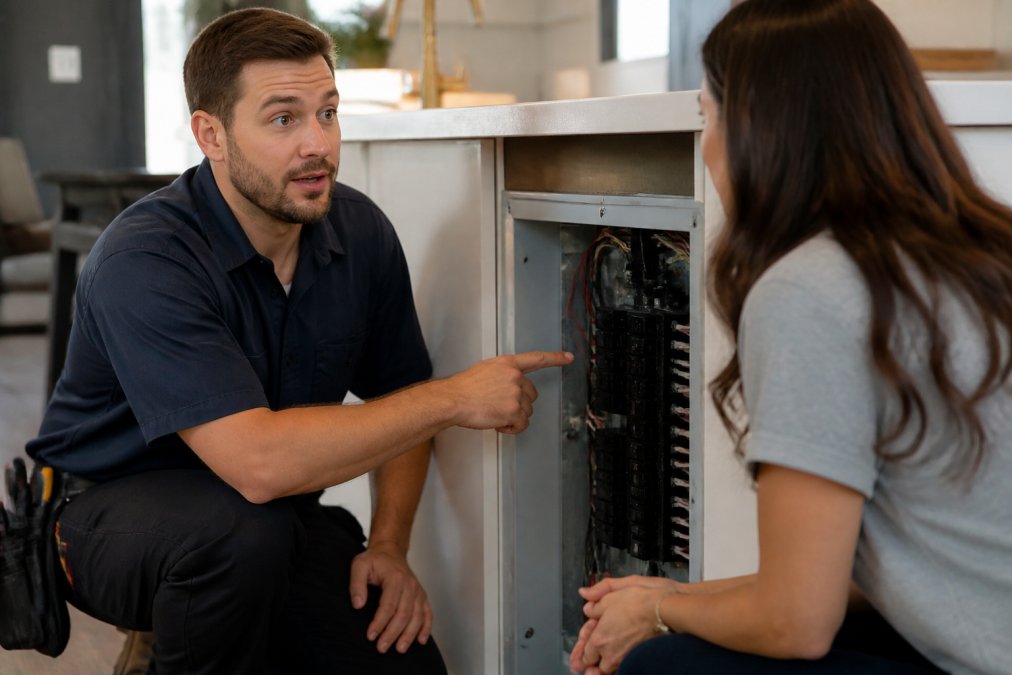
Translate Technical Jargon Into Plain Language
Plain language is the fastest way to build trust with a worried homeowner. When you say "your neutral conductor has a loose connection," you get a blank stare. When you say "a wire behind your wall came loose and that's why your lights flicker," you get a nod.
Here's a before-and-after table for the most common electrical customer questions:
| What Electricians Say | What Customers Hear | Plain-Language Version |
|---|---|---|
| "Your panel is overloaded" | Nothing useful | "Too many appliances are pulling power through one box" |
| "The GFCI tripped" | A code they don't know | "The safety outlet cut power to stop a shock risk" |
| "You need a load calculation" | A bill they can't predict | "I'll measure how much power your home actually uses" |
| "The grounding is faulty" | Danger, unexplained | "The safety path for stray electricity is broken" |
The same rule applies to wiring, outlets, and circuit breakers. Name the part, then say what it does.
Electrician Customer Service Scripts That Work
A good script isn't a robot reading lines. It's a safety net for the moments when a caller is upset and your brain wants to rush.
Try this structure for any inbound service call:
- Greet and confirm the address
- Ask what's happening right now
- Repeat the issue back
- State your arrival window
- Set expectations for the diagnostic process
Script for after-hours emergency calls: "Thanks for calling. I can hear this is urgent. Tell me what you're seeing, and I'll tell you what to do right now while we get a tech headed your way."
That last sentence does two jobs. It calms the caller and it moves the conversation toward a booking.
Handling Difficult Electrical Customer Complaints
Complaints rarely start with the electrical work. They start with a broken promise about timing, price, or communication. A homeowner who waited three hours past the arrival window isn't angry about voltage, they're angry about being left in the dark.
Use the LEAP method: Listen, Empathize, Apologize, Provide.
- Listen: Let them finish. No defending, no correcting the timeline mid-sentence.
- Empathize: "That would frustrate me too."
- Apologize: Own the gap, even a small one.
- Provide: Give one clear next step with a date.
What most guides miss is the apology step. Electricians hate admitting fault. But an apology for the experience isn't an admission of bad workmanship. It's professional integrity in action.
Scripts for the Four Complaint Types You'll Actually Get
Generic de-escalation advice falls apart the moment a real customer is on the line. Match the script to the complaint.
Price objection ("That's way more than the other guy quoted.") "I hear you, and that number deserves an explanation. Here's what's included: the permit, the inspection, the panel label, and a two-year workmanship warranty. If the other quote didn't list those, we're not comparing the same job. I can walk you through line by line right now."
The mechanism here is reframing scope, not defending price.
Delay complaint ("You said 10 a.m. It's 2 p.m.") "You're right, and I'm sorry. The job before yours turned into an emergency panel issue. Here's what I can do: I'm 40 minutes out, and I'll take $75 off the diagnostic for the wait. Does that work, or do you want to reschedule to first thing tomorrow?"
Give the customer a choice. A choice restores control, and control is what the delay took away.
Damage complaint ("Your tech cracked my drywall.") "Thank you for telling me.
The One Rule That Prevents Escalation
Never match the customer's volume. A raised voice on your end reads as guilt, even when you're right. Lower your pace, not your volume, slower speech signals control and gives the caller's nervous system something to sync to.
Log every complaint with three fields: what happened, what you promised, what you delivered. Patterns show up fast, the same tech, the same window, the same part. Fix the pattern, not the incident.
When to Escalate to the Owner
Front-line staff should handle price, delay, and rework complaints. Two categories go straight to the owner: anything involving a permit or inspection dispute, and anything where the customer mentions a lawyer, a licensing board, or a review platform by name. Those aren't service calls anymore, they're risk calls, and they need a different voice.
When to Give Estimates Before Answering Specific Questions
Never quote a firm price before a site assessment. This is the single hardest habit for new electricians to break.
The Range-With-a-Condition Script
Say this instead: "For a standard outlet on an existing circuit, most jobs land between $X and $Y. That range holds if the panel has room and the wall is standard drywall. If either of those is different, the number moves, and I'll tell you before I start, not after."
That script does four things at once:
- Gives the caller a real number, so they don't hang up
- Attaches the number to conditions they can understand
- Promises a re-quote before work begins, not after
- Positions you as the honest option when the next contractor quotes a suspiciously low flat rate
Diagnostic Fee vs. Repair Price
These are two different conversations, and mixing them is where most electricians get burned.
Handling the Phone Shopper
Some callers are collecting three bids and want your number to anchor the others. You can't win that game by playing it. You win by changing the question.
What to Put in Writing
Every estimate that leaves your truck should include four lines: the scope of work, the price, the exclusions (what's not included), and the validity window. Exclusions are the line most electricians skip, and they're the one that prevents the "but I thought that was included" call three weeks later.
Automating Electrical Customer Inquiries Without Losing the Human Touch
Automation handles the repetitive questions so you can focus on the technical ones. Most electrical customer inquiries after hours are the same five questions: Do you do emergency calls? What's your service area? What are your hours? Do you offer free estimates? Can you come today?
What AI Can and Cannot Handle
AI is good at:
- Capturing the caller's name, address, and issue
- Booking an appointment slot
- Answering service-area and hours questions
- Sending a text confirmation
AI should not:
- Diagnose an electrical hazard
- Quote a repair price
- Promise a specific arrival time outside your rules
Set clear boundaries. The AI captures the lead, you close it.
Visual Communication Strategies for On-Site Explanations
A photo beats a paragraph. When you're standing in a customer's basement explaining why their panel needs replacing, pull out your phone and take a picture of the burned bus bar.
- Photograph the problem before you touch anything
- Show the customer the photo on your screen
- Text them the same photo after the visit with a one-line note
Conclusion
Every missed call is a customer who dialed the next electrician on the list. The companies that grow aren't always the best troubleshooters. They're the ones who answer questions clearly, respond fast, and follow up.
Frequently Asked Questions
What are the most common electrical questions customers ask?
Customers most often ask about tripping circuit breakers, flickering lights, outlet replacement costs, and whether a job requires a permit. They also want to know if you handle emergency calls at night and what your service area covers. Preparing clear answers to these electrical customer questions before the call helps you respond quickly and confidently.
How do you explain complex electrical issues to non-technical customers?
Use analogies and avoid technical jargon. Instead of saying 'your neutral wire is loose,' say 'a connection inside your panel came loose, which is like a loose battery cable in a car.' Show the problem on a phone screen or a simple diagram. Confirm understanding by asking the customer to repeat back what they heard.
Can you give an example of a difficult customer complaint?
A common difficult complaint is a customer who believes they were overcharged for a simple outlet repair. They may raise their voice and question your workmanship. Using the LEAP method (Listen, Empathize, Apologize, Provide), you acknowledge their frustration, explain the diagnostic process and parts used, and offer a clear breakdown of the invoice.
Should you provide estimates before answering specific electrical questions?
Give ballpark ranges only after you understand the scope. For questions like 'How much to rewire a house?', explain that pricing depends on square footage, age of wiring, and local electrical code requirements. Offer a free site assessment or a flat diagnostic fee. Never guarantee a final price without seeing the electrical panel and load calculation.
SignatureCloud AI gives electrical contractors a 24/7 AI phone system and a professional website built for the trades. It captures leads after hours, answers common electrical customer questions automatically, and books appointments while you're on a job. If you're tired of losing calls to voicemail, get started with SignatureCloud AI and stop missing customers.